
Saturday, October 2, 2010


Hi-tech autowallahs hack digital meters!
The digital meters
were supposed to be tamper-proof. However, it has come to light that
they can be cleverly tampered by auto wallahs. This means you always end
up paying more than what you should according to the meter charge. It
came to light after Legal Metrology department officials revealed they
have booked 923 cases in 2010-11 against errant auto drivers using
tampered meters. They had booked 681 cases last year.Recently,
the department along with city traffic police decided to crack the whip
on auto-drivers. In a special drive, they booked a total of 7,865 cases.
Out of them, 335 cases were registered for extra fare demand and 250
for refusal to carry passengers. It is no secret that a road
corner mechanic or motor spare parts store worker can tamper with the
meter, whether it is digital or mechanical, at a charge of just Rs 200
to 250. When Expresso approached a mechanic near Balanagar crossroads,
he explained how meters can be tampered with. He charged Rs 250 for
doing the smart but simple job. “Tampering of a meter is very simple
which auto drivers can even do on their own. The gear-box housing just
requires a replacement to show double meter-reading. It costs about Rs
150 and gears inside it can be manipulated to show twice the distance
travelled,’’ he explained. A number of mechanics situated in
Khairatabad, Koti, Punjagutta, a few places in Secunderabad and
Balanagar are reportedly well-versed with the process. Controller
of Legal Metrology, SA Huda said auto drivers can tamper with the
meters easily. “No one shows interest in complaining about meter
tampering. If we receive a compliant, we will be ready to check and book
cases, if it can be proved. One can send their complaint directly to SA
Huda on his mobile 9848032375 or send an online complaint at
sahuda1@rediffmail.com.
By Mouli Mareedu
moulimareedu@gmail.com
Thursday, September 9, 2010
Drunkards using 108 ambulance to reach home
It is around
midnight, when a 40-year old calls up 108 and ‘’informs’’ that an
accident has taken place near RTC crossroads. He pleads with the staff
to send an ambulance post-haste. As the vehicle reaches the spot, the
man tells them he is a ‘’patient’’ and needs to go to the Gandhi
Hospital. But he gets down smugly at a little distance from the
hospital and vanishes into the dark. It is here that the driver realises
the man was drunk and just wanted a ‘lift’’. Of late, the
emergency ambulance service 108, is being used by drunkards to go home.
Even as hoax calls to the 108 service of the Emergency Management and
Research Institute (EMRI) has gradually gone down, the staff members are
perplexed whether to provide their service to the needy callers as
drunkards are misusing the service and giving false information.VNS
Prasad, regional manager (Operations), EMRI told Expresso that though
hoax calls have gradually gone down, a number of calls are being
received by the 108 call centre from drunkards who seem to be misusing
the service. “We are not able to attend to real emergencies due
to these fake calls. This has affected on our average response time as
the services are badly affected by drunkards repeatedly making false
calls,’’ he added.These fake calls are reportedly being made by
drunkards, mostly residing near the Osmania General Hospital, Gandhi
Hospital and other localities. They frequently make calls to the 108
emergency service call centre giving false information about the place
and incident. As soon as the 108 ambulance reaches the spot, they get in
the vehicle and direct staff members to go to a hospital near their
house. As the vehicle reaches near the hospital, they ask staff member
to stop the vehicle and simply walk out. Prasad said they are
planning to implement a ‘Dynamic Positioning’ system in an attempt to
combat potentially life-threatening problems. He said hoax calls could
cost lives as they tie up vital resources and hinder response times to
real emergencies.There are quite a few numbers which can be seen
from the graphic given, which have been making regular fake emergency
calls to the 108 emergency ambulance service.
 |
| EMRI, 108 Emergency service vehicle |
By Mouli Mareedu
Tuesday, September 7, 2010
Probe team suspects Amrita was on mobile
Was Amrita Roy, the
Air Asia employee, who died in a freak mishap on Sunday, busy in
conversation on her mobile when the operator started retracting the
aerobridge no 55 at the Rajiv Gandhi International Airport (RGIA)? A
three-member team of airport officials who began a probe on the mishap
have just this suspicion.Sources at the airport told Express that
Amrita had been alerted by her colleagues, while they were coming down
after finishing their work inside the aircraft.They said she was
standing near the edge of the aerobridge. “Perhaps, she was talking on
her mobile and was so engrossed in the conversation, that she failed to
take notice of it,” they said.Amrita Roy, a 25-year-old guest
service officer (GSO) of Air Asia was crushed to death on Sunday under
the retracting aerobridge, after passengers had boarded the Air Asia
AK-224 Kuala Lumpur-bound aircraft.As a matter of routine, four
to six aircraft employees wish all the passengers after they board the
aircraft and check all their ticket details. After the verification,
they submit the check report to the air hostess. Then, the aerobridge
operator retracts the aerobridge after a siren signal is given by the
concerned authorities.The three-member team comprising RGIA
deputy executive officer Vikram Jaisinghania, Delhi Airport chief
operating officer Peter Noyce and RGIA chief security secretary Uma
Ganapathi started their probe by meeting various Air Asia employees and
hearing their versions.The team also enquired with local police about the information gathered by them.They collected Amrita’s mobile phone to track the details to ascertain till what point of time she was talking on her mobile.Meanwhile,
autopsy reports of Amrita have ascertained that she died on the spot
due to ‘numerological shock’ rather than injuries. It revealed that her
right arm was completely damaged as it got trapped in the retracting
aerobridge.RGIA authorities said the investigation team would
reveal the details of the probe within three days, after collecting
information from the police, RGIA authority, other airline companies and
employees of Air Asia.
 |
| Its a file photo of Aerobridge at Rajive Gandhi International Airport |
By Mouli Mareedu
Monday, September 6, 2010
Air Asia employee dies in freak mishap
Just a few minutes
after she wished bon voyage to all the passengers who had boarded the
Air Asia AK 224, 25-year-old, Amrita Roy, Guest Service Officer of the
airline, bid farewell to the world. She died on the spot after she was
caught in a retracting aerobridge at the Rajiv Gandhi International
Airport (RGIA) here this morning.Amrita had promised her mother
Sudheekha Roy that she would return home early from work. But, it was
not to be.Amrita’s right arm got trapped in the aerobridge, which retracted after passengers had boarded the flight.The
accident took place around 9:30 am when Amrita got down from the
Kualalumpur-bound flight, Rajiv Gandhi International Airport Station
Inspector R Sanjay Kumar told Express. She was noting down a few points
on duty book when the retracting aerobridge swept her and crushed her to
death. She was rushed to the Apollo Medical Centre at the airport but
doctors declared her dead at 10.40 am.“The circumstances in which
the tragedy took place were bizarre. We are very upset. We are praying
that the family would be able to cope with the tragedy with fortitude. A
committee headed by Deputy CEO has been immediately formed, comprising
the Chief Operating Officer of Delhi Airport and Chief Security Officer
at Hyderabad Airport to investigate the incident,” said P Sripathy, CEO,
Hyderabad Airport.Amrita Roy was from Kolkata. She had been living at Attapur with her mother Sudheekha for the past few years.
 |
| Amrita Roy, Air Asia employee |
By Mouli Mareedu
Saturday, August 21, 2010
Varalakshmi Vratam hopes submerged in rain water
They wake up early
in the morning, clean their homes before smearing themselves with
turmeric paste and kumkum to perform Varalakshmi Vratam at the temple
every year on this day.But this year, a grim reality awaited
them. The locality of Madinaguda was submerged in flood water forcing
its residents to stay indoors. “As I went down from my flat to visit the
temple around 6 am, I saw rain water had reached the first floor of the
apartment. I was unable to go out,’’ added N Santhakumari, a home-maker
living in the Vaishnavi Apartments at Madinaguda.Similarly, 70
families staying in 20 apartments were forced to stay indoors in
Madinaguda, Deepti Sree Nagar, Hafeezpet, and surrounding localities of
Miyapur, as they were totally inundated with rain water with nearby
tanks overflowing. As tank bunds have been breached by heavy rains since
the past three days, overflowing water submerged the colonies since
early morning on Friday.PV Krishna Rao, a resident of Yasodha
Pearl told Expresso that as he went down to the basement to take out his
car at 6.30 a.m, he found it overflowing with rain water.“I went
out swimming on rain water to get a milk packet. After a few minutes,
the entire locality was completely under water. I could not return home
as the water force increased and I was unable to swim,” he said, as he
sat near his apartment holding a milk packet.Most two-wheelers and fourwheelers parked in the basements of apartments were submerged.Residents in the localities had to call up their friends and relatives to know about the prevailing situation.“I
came to know about it as my uncle called up in the morning and asked me
to inform GHMC officials and police. After informing the local police,
they refused to do anything so early in the morning. This is the first
time I ahve seen a deluge totally inundating the locality,” complained S
Kiran Kumar, busy enquiring about his relatives standing on the
national highway at Deepti Sree Nagar.As soon as news broke out,
electricity officials stopped power supply to at least 10 localities.
GHMC officials also brought two proclainers to clear rain water by
repairing underground drainage. They assured the locals they would bring
back normalcy within two days.Meanwhile, a private cab in which
five IT employees were travelling was washed away at Madhapur MMTS
railway station bridge due to heavy rain water force coming from the
nearby tanks. Kukatpally traffic police blocked the Kukatpally JNTU-
HiTec city stretch as rain water overflowed on the streets near the
Madhapur local train station. Traffic was diverted towards Hafeezpet.
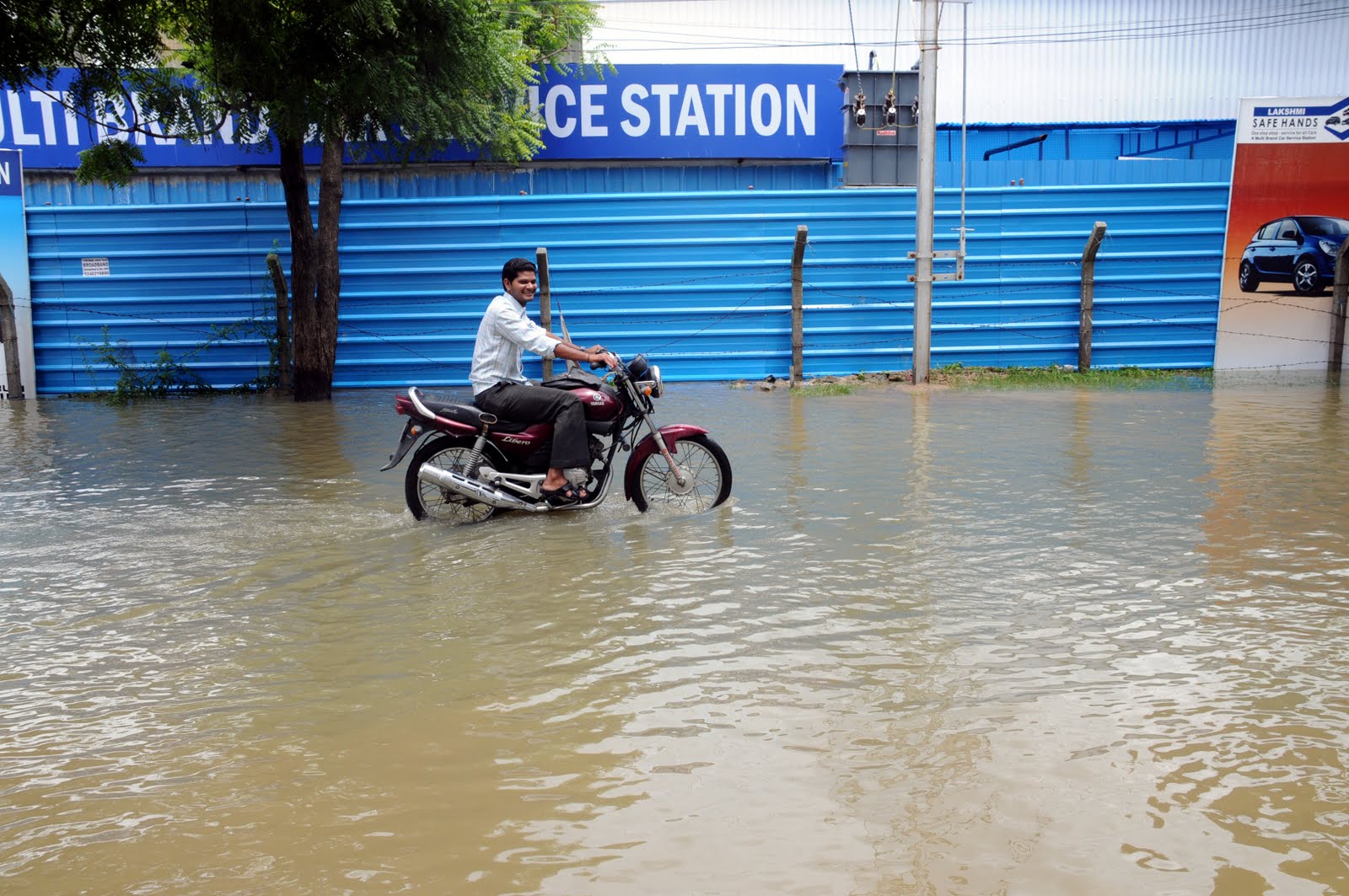 |
| Me, wading through the flood water at Deepti Shree colony in Madinaguda in the city as part my visit to cover the news |
By Mouli Mareedu
Monday, August 16, 2010
Look before you buy that mask
Do you think all
swine flu masks available in the market are medicated? Can they prevent
you from the dreaded swine flu? With swine flu deaths increasing in the
twin cities and in other districts of the state, the demand for swine
flu masks is increasing and many prefer to wear them for protection
against the H1N1 virus. However, all masks are not original and doctors
warn against using fake masks which might create a new health hazard.It
is believed the light-blue coloured masks available in the market are
fake and cannot prevent from the flu virus. When Expresso visited
various pharmacy shops located near the Gandhi General Hospital and
Osmania General Hospital, they had the fake swine flu masks on sale,
which were not medicated and certified by authorities concerned. They
were priced between Rs 60 and Rs120. “We have been selling swine
flu masks since one year. We don’t know whether the masks are medicated
or not. As there is a huge demand, we ordered more masks. We sell at
least 200 to 400 masks per day for Rs 50 each,” said Ch Narasimha Rao, a
medical store staff near the Gandhi Hospital.“There is no need
for every one to wear the masks. If someone wants to wear them
regularly, they have to change them every day. The N95 masks are
medicated and expensive. Only the government provides these masks to
doctors, nurses and para-medical staff working in various hospital
departments, especially in isolation swine flu wards,” said Dr SV
Prasad, superintendent of AP Government Chest Hospital. He advised
people to wear masks certified by IS 2000 and the National Institute for
Occupational Safety and Health (NIOSH). But the masks would not be
effective if one wears them for more than six hours. If you wear the
same mask regularly, it would cause breathing problems. Dr Prasad urged
people to be wary about fraudulent products for H1N1 flu prevention and
treatment.He said the N95 masks, technically called respirators,
work better than surgical masks which are certified by the Center for
Disease Control (CDC). The masks are deemed to provide specific levels
of protection from body fluid and blood penetration. NIOSH has also
certified that the N95 masks work against swine flu. The NIOSH has
approved the Type N95 respirator to meet the Occupational Safety and
Health Administration (OSHA) requirements and CDC guidelines for
tuberculosis exposure control. Prasad said the mask, when properly used
can filter germs from the breath and prevent spread of flu.Hyderabad
district medical and health officer, Dr Ch Jayakumari told Expresso
they would look into the matter and alert staff to make thorough checks
at medical stores. “However, the selling of fake swine flu masks in
pharmacies would come under the jurisdiction of the drug control
administration and they have to take action,” she adds.
By Mouli Mareedu
Subscribe to:
Posts (Atom)